
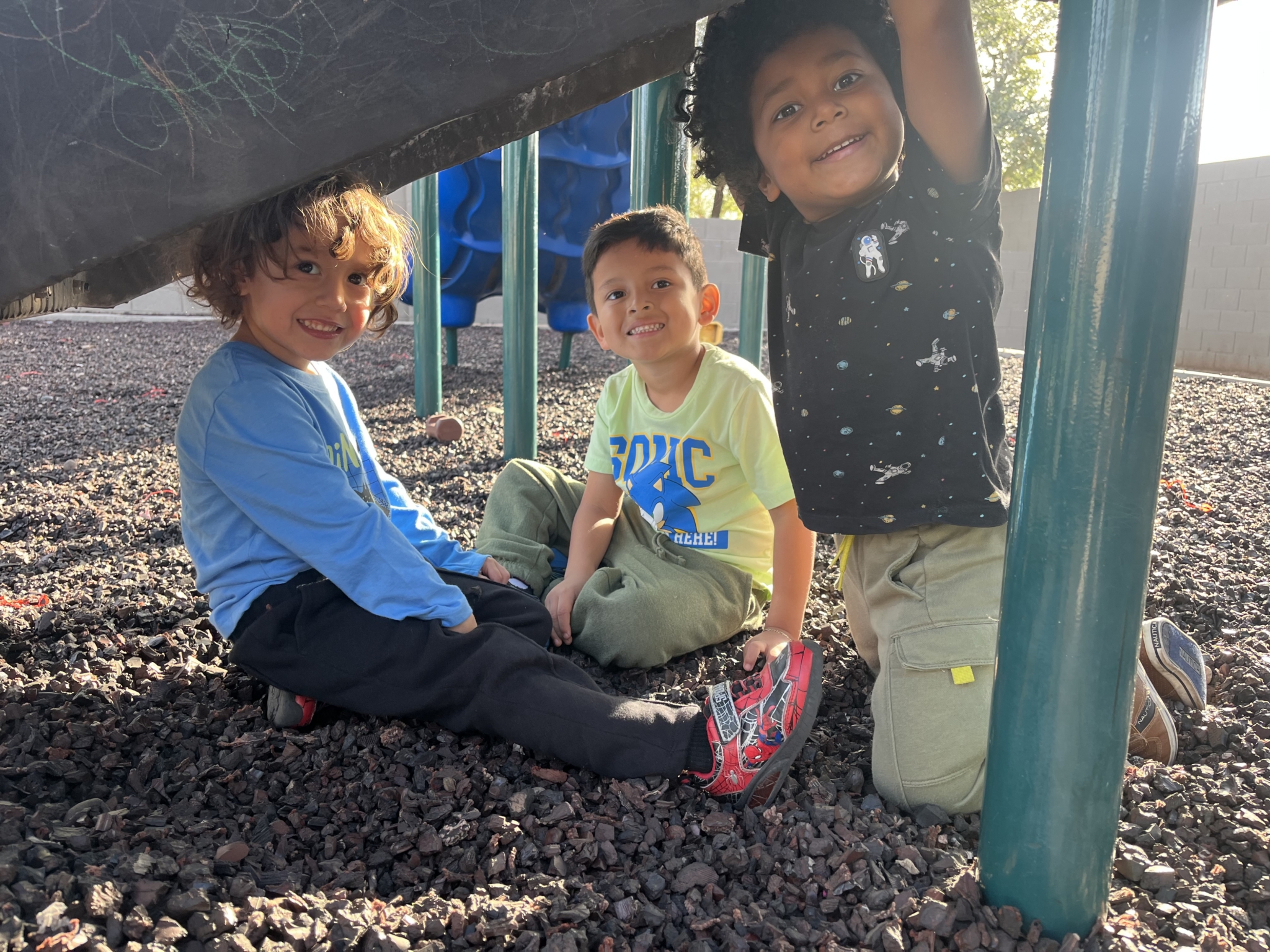
Every preschool day is full of small moments that ask a lot of a young child. Waiting for a turn on the slide. Saying “I’m still using that” instead of grabbing. Calming down after a block tower falls. Those moments are where social-emotional development happens, and they matter just as much as letters and numbers.
Social-emotional development in preschool is how young children learn to understand their own emotions, communicate their needs, build relationships with adults and peers, cooperate with others, and regulate their behavior. Between ages 3 and 5, children practice these skills every day through play, routines, and guided activities, and the confidence they build becomes the foundation for kindergarten and for life.
Here is what social-emotional development looks like in preschool, the skills to watch for, eight activities that build them, and how you can support the same growth at home.
What Is Social-Emotional Development in Preschool?
Social-emotional development is the process by which children learn to recognize what they feel, express it in healthy ways, and get along with the people around them. Educators often describe it using five connected areas, drawn from the framework developed by the Collaborative for Academic, Social, and Emotional Learning (CASEL):
- Self-awareness: noticing and naming feelings (“I’m frustrated”)
- Self-management: calming down, waiting, and handling disappointment
- Social awareness: noticing how a friend feels and showing empathy
- Relationship skills: joining play, sharing, listening, and working things out
- Responsible decision-making: making a kind or safe choice, even when it is hard
In a preschool classroom, this rarely looks like a lesson. It looks like a teacher kneeling to help two children figure out who had the truck first, or a morning circle where everyone shares how they are feeling. The learning is woven into the day, which is exactly why it sticks.

Why Are Social-Emotional Skills Important for Preschoolers?
Social-emotional skills are important for preschoolers because they make every other kind of learning possible. A child who can sit with a group, follow a simple direction, and recover from frustration is ready to absorb what a teacher is offering. A child who is overwhelmed by big feelings is not, no matter how bright they are.
Kindergarten teachers say this consistently: the children who settle in fastest are not always the ones who know the most letters. They are the ones who can take turns, ask for help, and manage a hard moment without falling apart. That is why social-emotional growth sits alongside early literacy and math on any good kindergarten readiness checklist.
The benefits reach well beyond school. Children who build these skills early tend to form stronger friendships, cope better with change, and carry a sturdier sense of confidence into the years ahead. Confidence in a four-year-old is the quiet belief that “I can handle this,” and it is built one successful hard moment at a time.
What Social-Emotional Skills Should Preschoolers Develop?
Every child grows on their own timeline, and a checklist is a guide, not a test. With that in mind, here is a preschool social-emotional development checklist based on the kinds of milestones the CDC and pediatricians look for between ages 3 and 5.
Around age 3, most children are starting to:
- Calm down within a few minutes after a parent leaves
- Notice other children and join them in play
- Name a few basic feelings (happy, sad, mad, scared)
- Follow simple classroom routines with reminders
Around age 4, most children are starting to:
- Comfort a friend who is hurt or sad
- Pretend to be someone else during play
- Ask before taking something and share with encouragement
- Use words, at least sometimes, instead of hitting or grabbing
Around age 5, most children are starting to:
- Follow rules and take turns in simple games
- Talk about their own feelings and recognize them in others
- Handle small disappointments without a major meltdown
- Show independence with tasks like cleanup and self-care
If your child is not doing everything on this list yet, that is normal. What matters is steady progress and a caring adult nearby to coach them through the tricky parts. If you have concerns about your child’s development, your pediatrician is the right place to start.
8 Social-Emotional Activities for Preschoolers
These are the kinds of social-emotional development activities you will see in a quality preschool classroom, and most of them work just as well at the kitchen table.
1. Feelings check-in with an emotion chart
At morning circle, each child points to a face on a feelings chart and says how they are doing today. What it builds: self-awareness and the vocabulary to talk about emotions instead of acting them out.
2. Belly breathing with a stuffed animal
Children lie on their backs with a small stuffed animal on their tummy and watch it rise and fall as they breathe slowly. What it builds: self-management. It gives children a calming tool they can use anywhere, and it makes an abstract idea (slowing down) something they can see.
3. Puppet problem-solving
A teacher uses two puppets to act out a familiar conflict, such as both wanting the same crayon, and the children help the puppets find a fair solution. What it builds: social awareness and problem-solving, in a low-pressure setting where nobody is in trouble.
4. Cooperative building challenge
Small groups get one bin of blocks and one goal: build a bridge a toy car can drive across. They have to plan, share pieces, and adjust when something falls. What it builds: cooperation, communication, and coping with frustration as a team.
5. Gratitude circle
Before lunch or at the end of the day, each child names one thing they are thankful for. It can be as small as “my blue shoes.” What it builds: a positive emotional habit and the ability to notice good things, even on a hard day.
6. Turn-taking games
Simple games like Simon Says, pass-the-ball, or a memory-matching game give children lots of practice waiting, watching, and cheering for someone else. What it builds: patience, listening, and the ability to lose without falling apart.
7. Mirror affirmations
Children look in a mirror and repeat short, encouraging phrases with the teacher: “I am kind. I am brave. I can try again.” What it builds: self-confidence and a hopeful inner voice that children carry into challenges.
8. Kindness jar
Whenever a child does something kind, such as helping a friend zip a coat, the class adds a pom-pom to a jar. When it fills up, everyone celebrates together. What it builds: social awareness and the understanding that kindness is noticed and valued.
How Preschool Helps Children Learn to Share and Cooperate
Preschool helps children learn to share and cooperate by giving them something no amount of coaching at home can fully replace: a room full of peers, every day, with a skilled adult nearby to guide the hard moments.
Sharing is not natural for a three-year-old. It is learned. Teachers support that learning by giving children the words (“Can I have a turn when you’re done?”), by setting up activities that only work with cooperation, and by stepping in as a calm mediator rather than a referee. Over time, children move from needing an adult to solve every conflict to trying it themselves first.
Classroom jobs, partner activities, and group projects all reinforce the same idea: we are a community, and everyone’s contribution matters. For a closer look at the specific skills children practice through play, see our post on social skills for preschoolers.
How Children Learn to Recognize and Manage Big Feelings
Children learn to recognize and manage big feelings in three steps: an adult names the feeling, the feeling is accepted, and the child is coached toward a healthy way to handle it.
That first step matters more than it sounds. “You’re feeling really angry because Mia took the shovel” gives a child a label for what is happening inside them. Feelings that have names are easier to manage than feelings that are just a storm.
The second step is acceptance. Good teachers separate the feeling from the behavior: it is okay to be angry; it is not okay to hit. Children who learn this do not become afraid of their own emotions.
The third step is co-regulation. A young child cannot calm down alone yet. They borrow calm from a steady adult who sits with them, breathes with them, and waits. Many classrooms include a cozy calm-down space with soft cushions, a few books, and a breathing visual, so children have a safe place to reset when feelings run high. With enough of these guided moments, children gradually build the ability to settle themselves.
How Mindfulness Supports Emotional Regulation
Mindfulness supports emotional regulation by teaching children to notice what they are feeling in their bodies and to pause before they react. For a preschooler, that pause is the whole game. It is the difference between a shove and a sentence.
Mindfulness at this age is simple and physical. Deep breathing. Noticing five things you can see. Feeling your feet on the floor. Saying what you are grateful for. Repeating an affirmation. These practices give children a concrete tool to reach for when a feeling gets big, and the more they practice when they are calm, the more available the tool is when they are not.
At Raising Arizona Preschool, mindfulness is not an add-on. Deep breathing, gratitude, affirmations, and self-regulation practice are built into the daily rhythm of our mindfulness-based curriculum, because we have watched what happens when children learn these tools early: fewer meltdowns, more empathy, and a classroom where children feel safe enough to take on the next hard thing.
How Parents Can Practice Social-Emotional Skills at Home
Parents can promote social-emotional development at home with small, consistent habits rather than special lessons. Here are a few that make a real difference:
- Name feelings out loud, including your own. “I’m feeling frustrated, so I’m going to take a deep breath.” Children learn regulation by watching it.
- Breathe together. Practice belly breathing at bedtime, when everyone is calm, so it is familiar when a tough moment comes.
- Read books about feelings. Pause to ask, “How do you think she feels? What could he do?”
- Play games with rules. Board games and simple card games are turn-taking practice in disguise.
- Give real jobs. Setting the table or feeding a pet builds responsibility and pride.
- Keep a gratitude ritual. One thankful thing at dinner is enough.
- Praise the effort, not just the outcome. “You waited so patiently for your turn” tells a child exactly what to do again.
Consistency matters more than perfection. A few of these, done most days, will do far more than any single big conversation.
When Should Parents Talk to Their Child’s Teacher?
Parents should talk to their child’s teacher whenever they notice a change in mood or behavior that lasts more than a couple of weeks, or whenever they simply want a clearer picture of how their child is doing socially. You never need a “big” reason.
Good times to reach out include:
- Your child seems withdrawn, unusually aggressive, or very anxious about school
- Drop-off has been hard for several weeks in a row (our guide to preschool separation anxiety can help in the meantime)
- Your child mentions not having friends or being left out
- There has been a change at home, such as a new sibling, a move, or a loss
- You are curious how a skill you are working on at home is showing up at school
A quality preschool welcomes these conversations. Teachers see your child in a setting you do not, and comparing notes is one of the most powerful things a parent and teacher can do together. If a concern persists across both home and school, your pediatrician can help you decide whether any additional support would be useful.
Frequently Asked Questions
What are social-emotional skills for preschoolers? Social-emotional skills for preschoolers include recognizing and naming feelings, calming down after getting upset, sharing and taking turns, listening to others, showing empathy, joining play, and using words to solve conflicts. Together, these skills help children build friendships and confidence.
Why is social-emotional development important in preschool? Social-emotional development is important in preschool because it prepares children to learn. Children who can manage their feelings, follow routines, and cooperate with peers adjust more easily to kindergarten, form stronger friendships, and are better able to focus on early literacy and math.
How does preschool foster social-emotional development? Preschool fosters social-emotional development through daily play with peers, consistent routines, and teachers who coach children through real moments of sharing, conflict, and frustration. Activities like feelings check-ins, breathing exercises, and cooperative projects give children guided practice every day.
How do preschoolers develop socially and emotionally? Preschoolers develop socially and emotionally through repetition and relationships. They learn by watching trusted adults, by trying skills during play, and by being coached, gently and often, through the moments that do not go well. Progress builds gradually between ages 3 and 5.
What is an example of social-emotional development in preschool? A common example is a child who used to grab a toy, learning to say “Can I have a turn?” and wait. Another is a child who takes three deep breaths in a calm-down corner instead of melting down. Both show growing self-management and communication.
How can parents promote social-emotional development? Parents can promote social-emotional development by naming feelings out loud, practicing calming tools like belly breathing, reading books about emotions, playing games with rules, giving children small responsibilities, and praising effort. Consistency at home reinforces what children practice at preschool.
See Social-Emotional Learning in Action
Reading about confidence is one thing. Watching a four-year-old take a deep breath, walk over to a friend, and say “I’m sorry, do you want to play?” is another. That is what our teachers work toward every day, in every classroom.
Raising Arizona Preschool is a Quality First-rated program where mindfulness, play, and a real joy for learning are at the center of everything we do. Our hand-selected teachers guide children through the social and emotional moments that shape who they are becoming, and we accept DES Child Care assistance so quality early education stays within reach for Arizona families.
Explore our programs for ages 1 to 12, learn more about our mindfulness-based curriculum, or visit us at one of our Valley locations: McDowell, Olive Ave, Mesa, or Glendale. Ready to see a classroom for yourself? Schedule a tour or contact us today. We would love to meet your family.