
Preschool Milestones: What Parents Can Expect
Somewhere between the third and fifth birthday, something remarkable happens. The toddler who communicated in single words starts telling you stories with a beginning and an end. The child who played alongside other children starts playing with them, negotiating who gets to be the firefighter. It is one of the most visible stretches of growth in all of childhood, and it is also the stretch when parents most often wonder whether their child is right on track.
That wondering is normal, and it usually comes with a lot of noise: a comment from a relative, a post from another parent, a friend’s four-year-old who already writes her name. This guide is meant to quiet some of that noise. Below you will find what most children do at ages 3, 4, and 5, organized by developmental area, drawn from the milestone checklists published by the CDC’s “Learn the Signs. Act Early.” program and developed with the American Academy of Pediatrics.
One thing to hold onto as you read: milestones are a general guide to development, not a test your child passes or fails. More on that at the end, in what may be the most important section of this article.
What Are Preschool Milestones?
Preschool developmental milestones are the skills that most children can do by a certain age, across areas like language, social-emotional growth, thinking and learning, movement, and self-care. The CDC defines a milestone as something most children, meaning 75 percent or more, can do by that age. Between ages 3 and 5, preschoolers typically move from short exchanges to real conversations, from playing near other children to playing with them, and from needing help with everyday routines to managing many of them independently.
Milestones are grouped into a few broad areas of development. Here is what parents most often notice in each one during the preschool years.
| Development area | Examples parents may notice |
| Language | Longer conversations, lots of questions, storytelling |
| Social-emotional | Turn-taking, expressing emotions, cooperative play |
| Cognitive | Sorting, counting, remembering routines |
| Fine motor | Drawing, manipulating small objects |
| Gross motor | Running, jumping, balancing |
| Independence | Dressing, cleaning up, following routines |
Two things are worth knowing about how these lists are built. First, they describe what most children do, which means a good number of children do some things earlier and some later. Second, the CDC is clear that milestone checklists are a way for families and providers to monitor development together, not a substitute for the standardized developmental screening a pediatrician performs.
Preschool Milestones at Age 3
By age 3, most children are talking well enough for people outside the family to understand them most of the time, asking constant questions, and starting to notice and join other children at play.
According to the CDC’s milestones for 3 years, most three-year-olds:
- Calm down within about 10 minutes after you leave, such as at a childcare drop-off
- Notice other children and join them to play
- Have a conversation with you using at least two back-and-forth exchanges
- Ask “who,” “what,” “where,” or “why” questions
- Say what is happening in a picture or book when asked, like “running” or “eating”
- Say their first name when asked
- Talk well enough for others to understand, most of the time
- Draw a circle after you show them how
- Avoid touching hot objects, like a stove, when you warn them
- String items together, like large beads or macaroni
- Put on some clothes by themselves, like loose pants or a jacket
- Use a fork
If your child is new to group care, that first milestone is often the one parents watch most closely. Settling within a few minutes of drop-off is a real developmental skill, and it is one that a warm, predictable classroom routine helps build. If goodbyes are currently hard at your house, our guide to easing preschool separation anxiety walks through what helps.
Preschool Milestones at Age 4
By age 4, most children are speaking in full sentences, telling you about their day, and using imagination as the engine of their play. This is the year pretend play takes over, and it is doing far more work than it appears to.
The CDC’s milestones for 4-year-olds note that most four-year-olds:
- Pretend to be something else during play, like a teacher, a superhero, or a dog
- Ask to go play with other children if none are around
- Comfort others who are hurt or sad, like hugging a crying friend
- Avoid danger, like not jumping from tall heights at the playground
- Like to be a “helper”
- Change their behavior based on where they are, such as a library versus a playground
- Say sentences with four or more words
- Say some words from a song, story, or nursery rhyme
- Talk about at least one thing that happened during their day
- Answer simple questions like “What is a coat for?”
- Name a few colors of items
- Tell what comes next in a well-known story
- Draw a person with three or more body parts
- Catch a large ball most of the time
- Serve themselves food or pour water, with adult supervision
- Unbutton some buttons
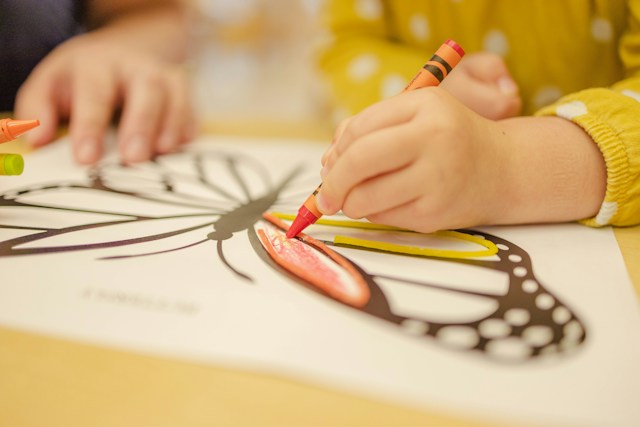
- Hold a crayon or pencil between fingers and thumb rather than in a fist
That last one matters more than it sounds. The shift from a fist grip to a finger-and-thumb grip is the foundation of comfortable writing later on, and it is built through everyday play. Our list of fine motor activities for preschoolers has simple ways to support it at home.
Preschool Milestones Around Age 5
By age 5, most children can follow rules in a game, tell a story with more than one event, count to 10, and stay with an activity for several minutes at a time. These are the skills that make a kindergarten classroom feel manageable rather than overwhelming.
Per the CDC’s milestones for 5-year-olds, most five-year-olds:
- Follow rules or take turns when playing games with other children
- Sing, dance, or act for you
- Do simple chores at home, like matching socks or clearing the table
- Tell a story they heard or made up with at least two events
- Answer simple questions about a book or story after you read it
- Keep a conversation going with more than three back-and-forth exchanges
- Use or recognize simple rhymes, like bat and cat
- Count to 10
- Name some numbers between 1 and 5 when you point to them
- Use words about time, like “yesterday,” “tomorrow,” “morning,” or “night”
- Pay attention for 5 to 10 minutes during an activity such as story time or art, not counting screen time
- Write some letters in their name
- Name some letters when you point to them
- Button some buttons
- Hop on one foot
If your child is heading to kindergarten within the year, these overlap heavily with what teachers look for on day one. Our kindergarten readiness checklist covers what else helps in that transition year.
Language and Communication Milestones
Language is often the area where preschool growth is most dramatic, because it moves from getting needs met to genuinely exchanging ideas.
At 3, most children hold a short two-turn conversation, ask a stream of who, what, and why questions, and are understandable to people outside the family most of the time. At 4, sentences stretch to four or more words, children recount something that happened during their day, and they answer questions about how things are used. By 5, most children can tell a story with at least two events, keep a conversation going across more than three back-and-forth turns, and recognize simple rhymes, which is an early signal that the ear is tuning in to the sound patterns behind reading.
What helps most at every one of those stages is the same thing: talk, read, and listen. Ask open questions, wait for the answer, and then ask one more.
Social and Emotional Milestones
Preschool social-emotional milestones describe how children manage their own feelings and connect with others, and they tend to be the milestones parents ask about most.
At 3, most children notice other children and join them, and they settle within about 10 minutes after a goodbye. At 4, they begin to play cooperatively rather than side by side, comfort a friend who is upset, ask to go play with other children, and adjust their behavior depending on where they are. By 5, most children can follow rules and take turns in a game with other children, which requires waiting, accepting an outcome they did not want, and staying in the game anyway.
None of this arrives automatically. Turn-taking, sharing, naming a feeling, and recovering after a conflict are learned through hundreds of small repetitions with patient adults nearby. That is exactly what a preschool day provides, and it is the heart of our approach to social-emotional development in preschool.
Cognitive and Early Learning Milestones
Preschool cognitive development milestones cover thinking, problem-solving, memory, and the earliest academic skills.
At 3, most children draw a circle after being shown how and understand a warning well enough to avoid a hot object. At 4, they name a few colors, tell what comes next in a familiar story, and draw a person with three or more body parts. By 5, most count to 10, name some numbers between 1 and 5, use words about time like yesterday and tomorrow, name some letters, write some letters in their name, and pay attention for 5 to 10 minutes during an activity.
Notice how much of that is built on ordinary routines. Counting the stairs, talking about what happens tomorrow, and rereading the same beloved book until your child can tell you what comes next are all cognitive practice.
Fine and Gross Motor Development
Motor milestones fall into two groups. Fine motor skills use the small muscles of the hands and fingers. Gross motor skills use the large muscles for running, climbing, and balancing.
On the fine motor side, most three-year-olds string large beads and use a fork. Most four-year-olds unbutton buttons, pour their own water with supervision, and hold a crayon between fingers and thumb. Most five-year-olds button some buttons and write some letters in their name.
On the gross motor side, most four-year-olds catch a large ball most of the time, and most five-year-olds hop on one foot. Alongside these, preschoolers are running, climbing, pedaling, and balancing their way toward the coordination and core strength that sitting at a table all morning in kindergarten quietly requires.
Independence and Self-Care Skills
Independence is the milestone area parents feel most in daily life, because it shows up as a morning routine that gets a little easier every month.
Most three-year-olds put on some clothes by themselves, like loose pants or a jacket, and feed themselves with a fork. Most four-year-olds serve their own food or pour water with an adult nearby and unbutton buttons. Most five-year-olds button buttons and do simple chores at home like matching socks or clearing the table.
Self-care skills grow fastest when children are given the chance to do things imperfectly. Extra minutes in the morning, a lower hook for the backpack, and a willingness to let the shirt go on backward are the actual curriculum here.
How Preschool Supports Developmental Growth
Preschool supports development by giving children daily, guided practice in all of these areas at once, with teachers who know what to look for and peers who make the social skills real.
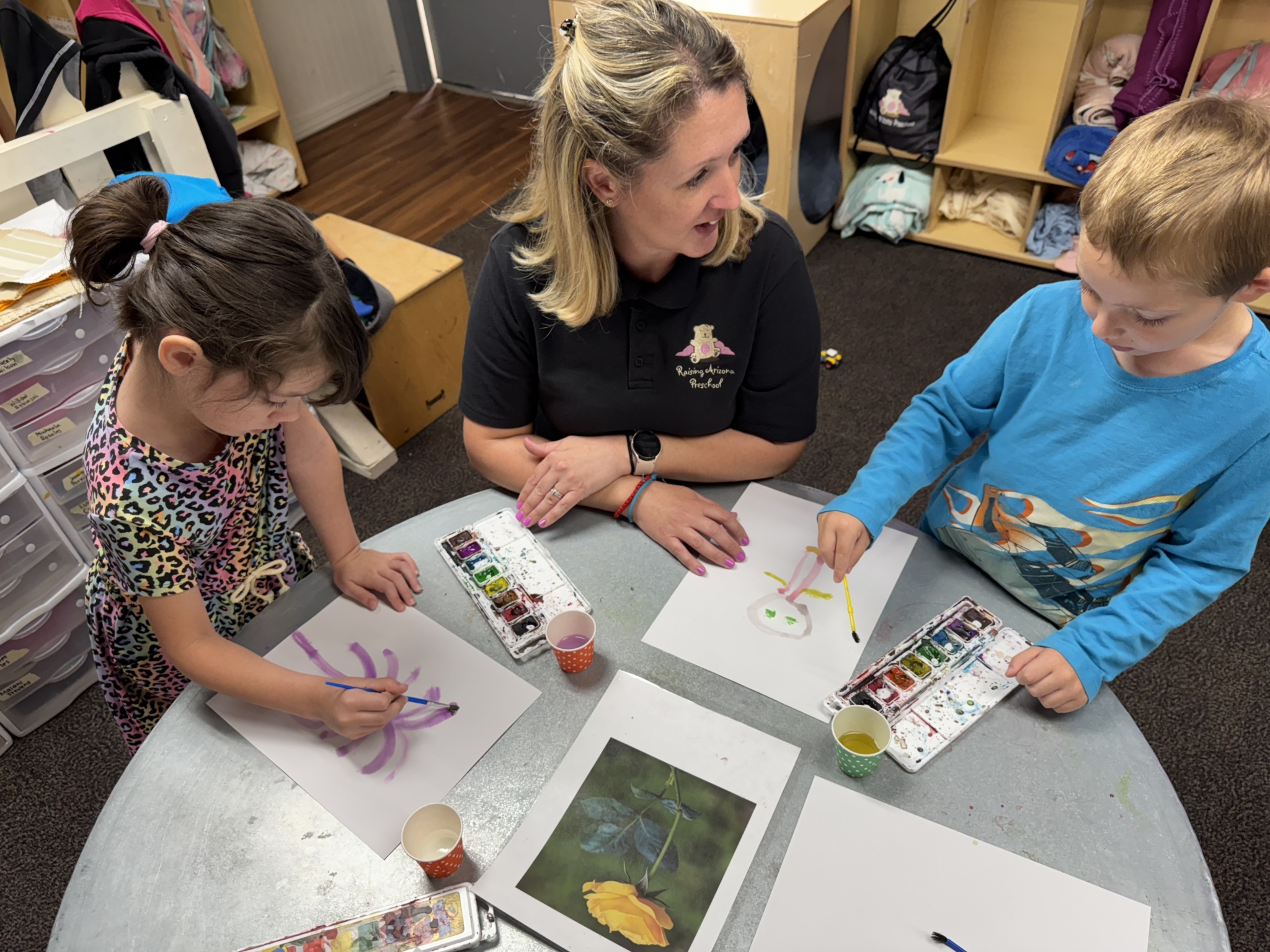
A well-designed preschool day is not a series of lessons. It is a predictable rhythm of circle time, choice-based play, outdoor movement, meals, rest, and small-group activities, and each part of it is doing developmental work. Circle time builds listening and attention. Choice time builds language, negotiation, and problem-solving. Art and building build fine motor control. The playground builds balance and coordination. Cleanup and handwashing build independence.
Teachers add the piece that is hard to replicate at home: trained eyes on a group of children the same age, every day. They notice when a child is ready for a harder puzzle, when a friendship needs a bridge, and when a skill has not shown up yet and might be worth a conversation with you at pickup.
At Raising Arizona Preschool, this is where our Quality First certified, mindfulness-based approach comes in. Children practice naming feelings, taking deep breaths, and resetting after frustration alongside letters, numbers, and climbing structures, because emotional skills and academic skills grow on the same schedule and support each other. You can see how it is structured on our curriculum page and across our preschool and pre-K programs.
What If My Child Develops at a Different Pace?
Milestones are a general guide to development, not a diagnostic test. Every child develops on their own timeline, and reaching a skill somewhat earlier or later than a checklist suggests is common and often means nothing at all.
It helps to remember what a milestone actually represents. The CDC selected these skills as things that most children, 75 percent or more, can do by a given age. That leaves real room on either side. Children who were born prematurely, who are growing up bilingual, who have had a big change at home, or who simply put their energy into one area before another may show a different pattern, and many of them catch up without any intervention at all.
What matters more than any single item on a list is the overall picture, and your own sense of your child. The CDC’s guidance is to act early if your child is not meeting one or more milestones, has lost a skill they once had, or if you have any other concern. Acting early does not mean panicking. It means asking.
Here is a simple path if you have a question:
- Write down what you are noticing. A few specific examples, such as how your child asks for something or how they play with other children, are far more useful than a general worry.
- Talk with your child’s pediatrician. Share what you have noticed and ask about developmental screening, which uses standardized, validated tools rather than a checklist.
- Talk with your child’s teacher. Teachers see your child in a group setting all day and can tell you what they observe and what they are already doing to support that skill.
- Ask about a free developmental screening. In Arizona, children from birth to just under 3 are served through the Arizona Early Intervention Program, and children roughly age 3 through 5 can be screened through their local public school district under AZ FIND, Arizona’s Child Find initiative. Contact information, eligibility, and screening schedules vary by district and can change, so confirm the current process directly with AZ FIND through the Arizona Department of Education or your local district office.
- Keep going either way. Reading, talking, playing, and letting your child try things independently support development regardless of what a screening shows.
One more reassurance, because it bears saying plainly. Asking a question about your child’s development is not an admission that something is wrong. It is one of the most protective things a parent can do, and the earlier a question gets asked, the more options there tend to be.
Frequently Asked Questions
What milestones should a 3-year-old reach? By age 3, most children can hold a short conversation with at least two back-and-forth exchanges, ask who, what, where, and why questions, speak clearly enough for others to understand most of the time, notice other children and join them to play, calm down within about 10 minutes after a goodbye, draw a circle after being shown how, string large beads, put on some clothes by themselves, and use a fork.
What should a 4-year-old know? Most four-year-olds say sentences of four or more words, talk about something that happened during their day, name a few colors, tell what comes next in a familiar story, draw a person with three or more body parts, pretend to be something else during play, comfort a friend who is upset, catch a large ball most of the time, and hold a crayon between their fingers and thumb.
What skills do preschoolers develop between ages 3 and 5? Preschoolers develop across six broad areas: language and communication, social-emotional skills, cognitive and early learning skills, fine motor control, gross motor coordination, and independence and self-care. In practice, this looks like longer conversations, cooperative play, counting and letter recognition, drawing and cutting, running and balancing, and managing more of their own routine.
What are social-emotional milestones for preschoolers? Social-emotional milestones describe how children handle their feelings and relate to others. At 3, most children join other children in play and settle after a goodbye. At 4, they play cooperatively, comfort others, and adjust their behavior to different settings. By 5, most can follow rules and take turns in a game with other children.
What cognitive skills develop during preschool? Preschool cognitive development includes memory, problem-solving, and early academics. Most three-year-olds can draw a circle when shown how. Most four-year-olds name colors and predict what comes next in a familiar story. Most five-year-olds count to 10, recognize some letters and numbers, use words about time, and pay attention for 5 to 10 minutes during an activity.
What fine motor skills should preschoolers have? Most three-year-olds string large beads and use a fork. Most four-year-olds unbutton buttons, pour water with supervision, and hold a crayon between fingers and thumb instead of in a fist. Most five-year-olds button buttons and write some letters in their name.
How does preschool support child development? Preschool gives children daily practice in every developmental area within a predictable routine, guided by trained teachers and surrounded by peers the same age. Circle time builds attention, play builds language and problem-solving, art builds fine motor control, outdoor time builds coordination, and routines build independence.
Do all children reach milestones at the same age? No. Milestones describe what most children, 75 percent or more, can do by a certain age, which means many children reach them earlier or later. A milestone checklist is a general developmental guide, not a diagnostic test. If your child is not meeting one or more milestones, has lost a skill they once had, or you have any other concern, talk with your pediatrician and ask about developmental screening.
Watch your child grow with us
Every milestone in this guide is something children practice, not something they arrive with. At Raising Arizona Preschool, that practice happens all day long, in classrooms built around play, mindfulness, and genuine joy for learning, with hand-selected teachers who know what to look for and how to celebrate it.
If you would like to see what that looks like in person, explore our preschool and pre-K programs, take a closer look at our curriculum, or find the campus nearest you in McDowell, Olive Ave, Mesa, or Glendale. Questions about your child’s stage or which classroom would be the right fit? Get in touch, and we will walk you through it.
Schedule a tour and see the next milestone in the making.
Sources
- CDC, Learn the Signs. Act Early., Milestones by 3 Years
- CDC, Learn the Signs. Act Early., Milestones by 4 Years
- CDC, Learn the Signs. Act Early., Milestones by 5 Years
- CDC, Learn the Signs. Act Early., Developmental Milestones overview
- Arizona Department of Education, AZ FIND
This article is for general informational purposes and reflects CDC milestone guidance developed with the American Academy of Pediatrics, as published at the time of writing. It is not medical advice, and milestone checklists are not a substitute for standardized developmental screening. Always talk with your child’s pediatrician about your individual child’s development.